
— Deegant Adhvaryu

As someone who grew up in Los Angeles, I never thought about walkability and transit due to the car-centric environment. A career move to Washington D.C. changed my perspective significantly. For the first time in my life, I commuted daily on the Metro and began prioritizing more of a car-free lifestyle. I became more cognizant of the beneficial effects of transit-oriented planning, safety, sustainability, and how it allows for a more organic community environment. Not to mention, it’s far more equitable for the population and helps individuals integrate into a city and its identity.
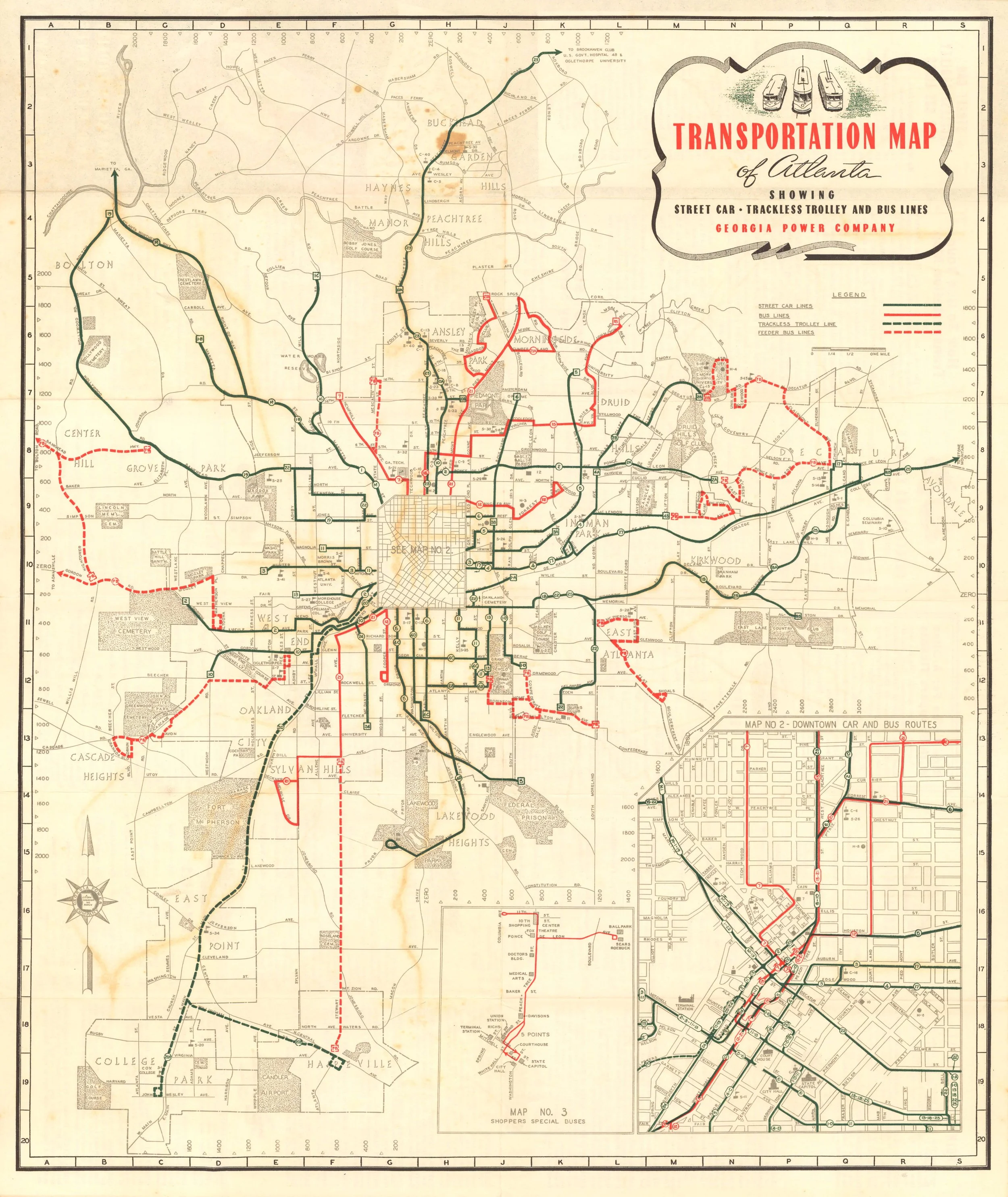
Transportation Map of Atlanta showing Street Car, Trackless Trolley, and Bus Lines of the Georgia Power Company, circa 1950s, courtesy of Georgia State University Library
After moving to Atlanta a few years ago, I wanted to recover this lifestyle with Atlanta’s own metro rail system, MARTA. I use the mass transit system as much as possible to commute to work, visit my parents, or get to events around the city. Sadly, the transit infrastructure in Atlanta is not what it should be. Atlanta once housed one of the most extensive streetcar networks in the United States.
The current Atlanta streetcar, a sleek and quiet vehicle that makes its rounds between Centennial Olympic Park and the neighborhood of Sweet Auburn, with a central stop at Peachtree Center Station, is often maligned by people as having poor utility due to its low ridership and limited coverage. Enter the solution: Beltline Rail, beginning with the Streetcar East Extension to Ponce City Market. This does wonders for expanding the downtown streetcar eastward to the Beltline.
I’ve been a resident of Poncey Highland with my wife for 2 years, and completely fell in love with the neighborhood, the liveliness, the shops and restaurants within walking distance (the Plaza Theatre being a frequent stop of ours), and the plethora of bus stops a few steps away from our home.
For someone like me, who works near Five Points Station, the Beltline rail would open new transit options for getting to work and even more options after work. My wife and I could very easily head to the Krog District, or Ponce City Market for dinner via light rail. A proper transit connection between Downtown and one of the busiest segments of the Beltline grants Atlantans (ATLiens) a rapid way to access these neighborhoods. I have no doubt that this would greatly assist the city in reducing traffic by lessening its dependence on cars. This will increase pedestrian safety and contribute towards better air quality.
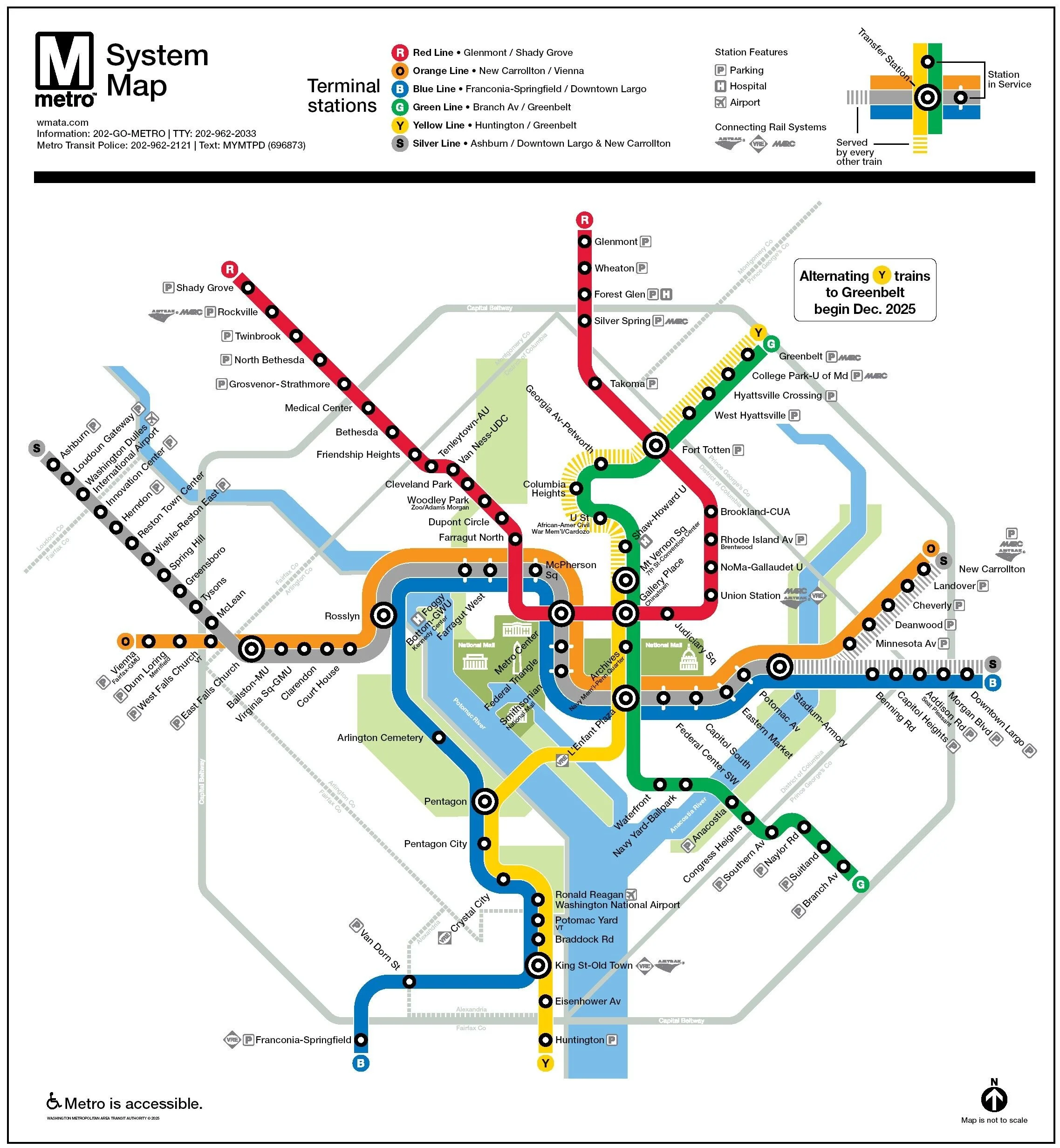
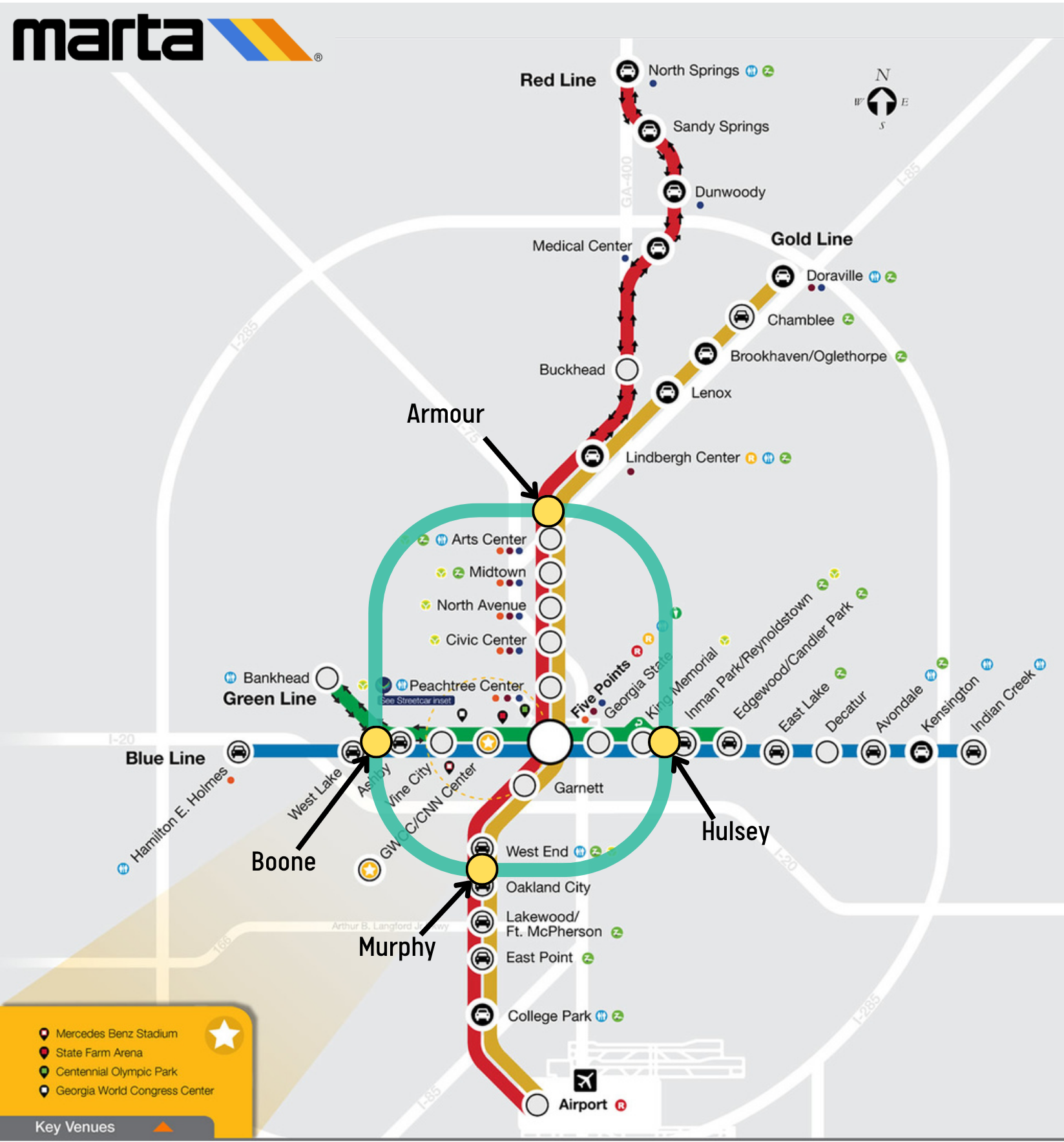
The Metrorail system in Washington, DC, that Deegant recalls so fondly is a network of interlocking lines that reach all parts of the city and its suburbs. Beltline light rail, with its circular layout and connections among the city's inner neighborhoods, will have a similar effect, extending transit reach and usability for all city residents. Maps provided by Washington Metropolitan Area Transit Authority and MARTA (Beltline rail superimposed by BRN)
The project in its totality, 22 miles of concentric light rail coverage, will be a lengthy undertaking, but its value and utility cannot be understated. In its final form, we would have a light rail loop with 5 intersections with the heavy rail system, providing the city with long-overdue transit connectivity for nearly 4 dozen Atlanta neighborhoods. For this reason, the Streetcar East Extension needs to break ground as soon as possible. For starters, it generates momentum. When the people of the city see and know that our transit system is being actively expanded, it will instill confidence that there is a commitment to improvement in our government, and that work is ongoing. This increases public trust. It also sends a positive message to Atlanta metro counties that have previously resisted joining the MARTA network. Mayor Dickens has recently expressed his desire to open further talks with these counties in hopes that they will agree to join. What better way to convince them than to demonstrate how committed the city of Atlanta is to the transit infrastructure within its jurisdiction?
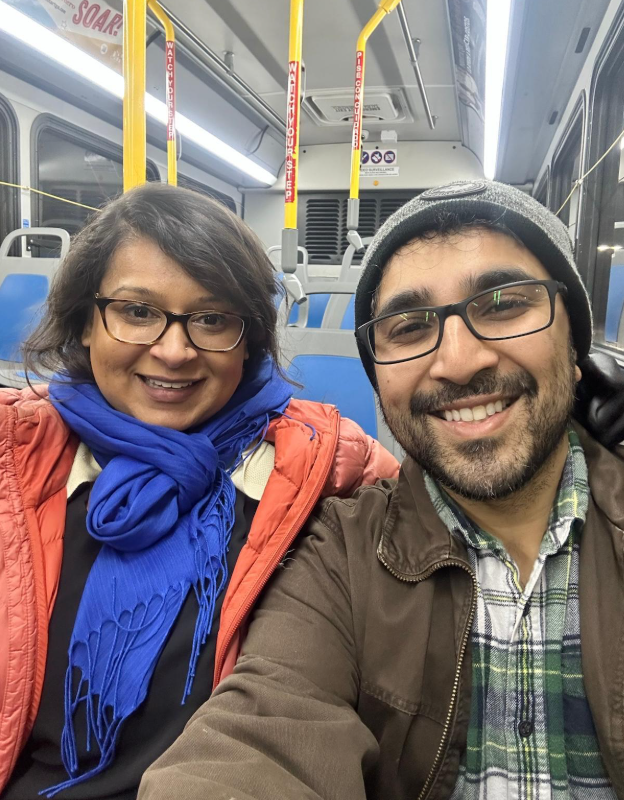
Deegant and his wife Neha are frequent bus riders. She likes to joke that she reserved a private bus for them whenever they board an empty one
Beltline Rail is truly an ambitious project; if the city can achieve the vision as originally drafted, Atlanta would arguably have one of the most unique and effective light rail systems in the nation, if not the world, along with 22 miles of a mixed-use path shared with a streetcar. It would designate Atlanta as a foremost leader in American transit innovation, and I don’t think we should pass up this opportunity. The city has already voted to make it happen, and has completed all of the lead-up work necessary to begin breaking ground on the project. It has funded the first segment. If the city waffles now, the entire project could be jeopardized. The mayor would like to shelve the Eastside project for now and focus on the Southside rail project. But how long will that take? And what’s to say the same entities that disrupted the Streetcar East project don’t end up doing the same to Southside rail once that segment of the beltline develops further?
I know that for my wife and me, if this project doesn’t happen, transit times all over the city will continue to get worse, for our work commute, for going out to dinner, or attending events. Atlanta proper is seeing a healthy annual population gain. Unless we expand our transit options, the vast majority of these transplants will be forced to drive to get around, further straining our roads. I believe it is imperative that Beltline rail, beginning with the shovel-ready Streetcar East Extension, is constructed. It is integral to our city’s transit network and crucial to building public trust that Atlanta is serious about forging a sustainable path forward for all of its citizens, old and young, legacy and newcomers.

Deegant is a digital forensic analyst in the public sector, living in Poncey-Highland. He enjoys watching movies, going to concerts, and exploring cities. He looks forward to a car-lite or even car-free life one day.
